
7 Signs Your Gutters Are Failing
Gutters usually warn you before they fail outright. Learn the seven signs — from overflow and sagging to foundation staining — and what each one is telling you.
Gutters work by catching roof runoff at the eave and channeling it, on a slight slope, to downspouts that carry it away from the foundation. They fail for only a few reasons — clogs, the wrong size, a lost slope, or loose hangers — and each one has a recognizable warning sign.
Gutters are one of the least glamorous parts of a house and one of the most consequential. A working gutter system is the difference between roof water leaving quietly through a downspout and the same water pouring down your siding, pooling at the foundation and finding its way into a basement. Understanding how gutters work makes every later decision — sizing, guards, cleaning, drainage — much easier.
When rain hits a sloped roof, it does not fall straight down. It runs along the roof surface, gathers speed, and concentrates at the lowest edge — the eave. A gutter is a channel bolted just below that edge to catch the sheet of water before it drops, and to redirect it sideways toward a vertical pipe called a downspout.
From there the job is simple to describe and easy to get wrong:
Every gutter problem is a breakdown somewhere in those four steps.
You do not need to be an installer to recognize the main components. Knowing the vocabulary makes diagnosing problems far easier.
| Part | What it does |
|---|---|
| Gutter (trough) | The horizontal channel that catches roof runoff at the eave |
| Downspout | The vertical pipe that carries water from the gutter to the ground |
| Outlet | The hole where the gutter drains into the downspout |
| Hangers | Brackets that hold the gutter to the fascia at the correct slope |
| End cap | Closes the end of a gutter run |
| Elbow | An angled fitting that redirects a downspout around the house |
| Splash block / extension | Directs discharged water away from the foundation |
The trough and downspout get the attention, but the hangers and slope quietly determine whether the whole system keeps working over time.
A gutter is not level. It is pitched very slightly toward its downspout so gravity keeps water moving instead of standing. Standing water is the enemy: it breeds corrosion, deposits sediment, freezes in winter and adds weight that pulls the gutter loose.
The pitch is small — often around a quarter inch of drop per 10 feet — which is why a sagging hanger or a settled section can quietly erase it. Once slope is lost, water pools at the low spot, debris collects there, and the trough begins to overflow long before it is truly “full.”
A gutter that holds a shallow line of water after the rain has stopped has usually lost its slope. That standing water is an early warning, not a cosmetic detail.
Gutters come in standard widths — five-inch and six-inch are the common residential sizes — and downspouts in matching dimensions. The right size depends on how much water the roof delivers, which is driven by three things:
A large, steep roof in a region with intense storms can overwhelm a five-inch gutter even when it is perfectly clean. That is why “my gutters are clean but still overflow” is such a common complaint — the system is simply undersized for the water it has to move. Adding capacity usually means larger gutters, larger or additional downspouts, or both.
Nearly every gutter problem traces back to one of four causes. The value of understanding the system is that the symptom usually tells you which one.
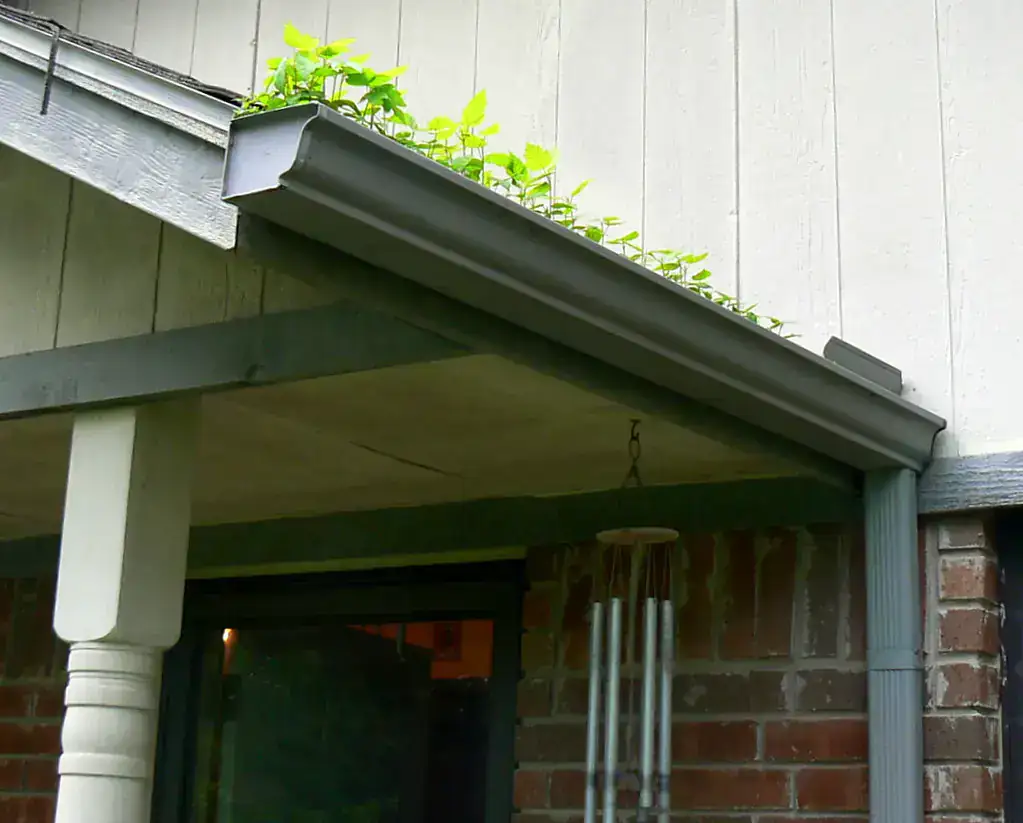
Leaves, pine needles, roof grit and seeds collect in the trough and, more importantly, at the outlet where water enters the downspout. A blocked outlet backs water up the entire run. Clogs are the most common cause of overflow, and the most seasonal — expect them after autumn leaf drop and after storms.
If a clean, well-sloped gutter still overflows in heavy rain, the system likely cannot handle the roof’s water volume. This is a capacity problem, not a maintenance one.
Sagging hangers, a section that has pulled away from the fascia, or settling over years can flatten the pitch. Water then pools and overflows at the low point even when nothing is blocked.
Sectional gutters leak at their seams as sealant ages. Hangers loosen, and the fascia board behind them can soften from chronic moisture, letting the whole run pull away. Leaks tend to show up as stains on the fascia or a steady drip at a joint.
A note on safety. Diagnosing gutters usually means getting up high. Working on a ladder or roof carries a real risk of falling, and that risk rises with height, wet surfaces and older or damaged fascia. Much of what this article describes — overflow patterns, staining, sagging — can be observed from the ground during a rain. If you do not have safe, stable access, gutter inspection and repair are best handled by a professional with the right equipment.
The reason it helps to see gutters as a system is that the parts depend on each other. A correctly sized gutter still fails if the downspout is undersized. A clean gutter still overflows if it has lost its slope. A perfect gutter run still causes a wet basement if the downspout discharges at the wall. When something goes wrong, walk the water’s path — eave to trough, trough to outlet, outlet to downspout, downspout to the ground — and the failure point usually reveals itself.
That same path is the backbone of the rest of this site: downspouts pick up where the gutter ends, underground and yard drainage decide where the water finally goes, and foundation protection is what all of it is ultimately for.
FAQ
Most do, but not all. Homes with wide roof overhangs, well-graded soil that already slopes away, and no basement can sometimes manage runoff without gutters. Homes with short eaves, a basement or crawl space, or flat surrounding ground almost always benefit from them. The deciding factor is where roof water lands and whether the ground moves it away from the foundation.
A common rule of thumb is roughly a quarter to a half inch of fall for every 10 feet of run, so water keeps moving toward the downspout. This is guidance, not a code figure — long runs are often pitched from a high point in the middle toward downspouts at both ends. Confirm specifics against your gutter manufacturer's instructions and any local requirements.
Sectional gutters come in pre-cut lengths joined with connectors, which creates seams that can eventually leak. Seamless gutters are formed on-site from a continuous coil, so the only joints are at corners and outlets. Seamless systems have fewer leak points; sectional systems are easier to buy and repair in pieces.
Clean gutters can still overflow if they are undersized for the roof area, if the downspouts are too few or too small, or if water is sheeting off a steep roof faster than the gutter can capture it. Overflow that happens only in heavy downpours often points to capacity, not clogs.
Aluminium gutters commonly last around 20 years, steel somewhat less depending on coating and rust, and copper can last 50 years or more. Lifespan depends heavily on maintenance, climate and how well water is kept moving through the system.
Extending a downspout helps move water farther from the foundation, but it does not fix a gutter that no longer drains. If water stands in the trough, the problem is upstream — slope, clogs or sagging — and the extension only manages what actually reaches the bottom.
Keep reading
Gutters usually warn you before they fail outright. Learn the seven signs — from overflow and sagging to foundation staining — and what each one is telling you.
How splash guards and valley diverters stop concentrated valley runoff from shooting over the front of the gutter.
How to clean gutters step by step — clearing debris, flushing the run, clearing downspouts and inspecting as you go — with safety front and center.