How to Tell If Your Gutters Need Cleaning
The ground-level signs your gutters need cleaning — overflow in rain, sprouting plants, fascia streaks, sagging, and nesting — plus how to check safely.
Seasonal Maintenance

Dry gutter cleaning scoops debris out by hand or vacuum before flushing; wet cleaning flushes everything through with water. Dry-first is tidier and lets you check the trough; wet-only is faster but can pack debris into the downspout. Most good cleanings do both.
Short answer: dry cleaning scoops the debris out by hand or vacuum before any water touches the gutter; wet cleaning flushes everything straight through with water. Dry-first is tidier and lets you actually see the trough, while wet-only is faster but can pack debris down into the downspout and clog it. The best cleanings usually combine the two — scoop, then flush.
Every gutter cleaning has to answer one question: how does the debris get out? There are only two mechanisms. You can lift it out — by hand, scoop, or vacuum — before introducing water. Or you can wash it out, letting a hose carry everything through the trough and down the spout. Those are the dry and wet methods, and most of the practical differences between them flow from that single choice.
Neither is exotic. The debate is less “which tool” than “which order,” and the order turns out to matter more than people expect.
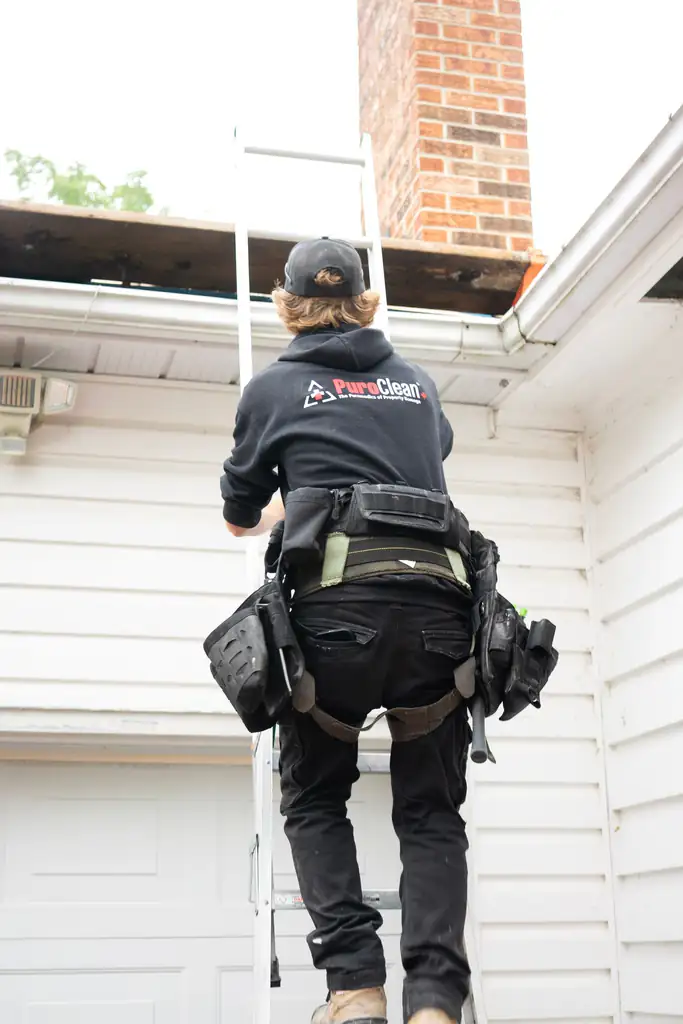
Working at height is dangerous. Ladder and roof work risks serious falls, worse on wet or icy surfaces; if you lack safe, stable access, hire a professional.
Dry cleaning removes the bulk of the debris before water enters the picture. You work along the trough with a scoop or a gloved hand, dropping leaves, twigs, and packed sediment into a bucket or onto a tarp. A wet/dry vacuum can do the same job, pulling out material — including fine grit — through an extension.
The advantage is control and visibility. As you clear, you can see the bottom of the trough: the low spots, the rust, the loose hangers, the seams. You are removing the debris rather than relocating it, so nothing heads for the downspout uninvited. The trade-off is that dry cleaning alone leaves a film of fine residue and, on its own, never tests whether the outlet actually drains.
Wet cleaning skips the removal step. You aim a hose down the gutter and let the water push everything toward the downspout and out. On a lightly soiled gutter — a thin layer of grit, a few loose bits — this can be quick and effective, carrying the light material through without incident.
The speed is real. So is the risk, and it has a specific shape.
Here is the catch with wet-only cleaning on a debris-filled gutter. The trough is wide and open; the downspout is narrow. When you flush a gutter full of wet leaves, all that material converges on the one small exit. Instead of flowing through, it compacts at the elbow or partway down the vertical run and forms a clog — often denser and more stubborn than the loose mess you started with.
You have then traded a visible, easy-to-scoop problem for a hidden one inside a pipe. Clearing it means fishing from the top, flushing from the bottom, or running an auger, none of which is as simple as lifting the debris out before it ever moved. If a downspout ends up blocked this way, our guide to why a downspout is not draining covers how to work it loose without making things worse.
The strongest method borrows from both. Remove the bulk of the debris dry, so nothing heavy is left to jam the outlet. Then flush with the hose to carry off the fine residue and — the part that matters most — to confirm the downspout runs at full flow. The flush is not just cleanup; it is your test. Water in the top should exit the bottom in a strong, steady stream, not a trickle or a gurgle.
Dry-then-flush is tidier, it lets you inspect the trough while it is empty, and it sharply lowers the odds of packing the downspout. The only cost is a little more time, which is a fair price for a cleaning that actually holds.
| Aspect | Dry (scoop/vacuum, then flush) | Wet-only (flush through) |
|---|---|---|
| Speed | Slower — removal takes time | Faster on light debris |
| Downspout risk | Low — bulk removed before flushing | Higher — debris can pack the outlet |
| Trough inspection | Good — you see the empty trough | Poor — debris and water obscure it |
| Mess control | Contained in bucket or tarp | Washes out the outlet, can splatter |
| Best suited to | Most gutters, especially leaf-heavy | Lightly soiled gutters only |
| Confirms drainage | Yes, via the final flush | Only if the outlet stays clear |
The table points one way for most homes: dry-first is the safer default, with wet-only reserved for gutters that are barely dirty. Which tools you reach for within each method is its own subject — our guide to gutter cleaning tools and methods lays out the scoop, vacuum, and hose choices and when each fits.
Debris load, gutter size, and downspout layout all vary. Use this comparison as a general guide, and adjust to what you find in your own troughs rather than applying one method everywhere.
Wet versus dry is not really a contest — it is a sequence. Take the debris out dry so it cannot jam the outlet, then flush to clear the fines and prove the downspout runs. Do both, in that order, and you get the tidiness of dry cleaning, the finish of a flush, and a downspout that is clear rather than freshly packed.
FAQ
Dry cleaning removes debris by hand or vacuum before any water is used, then finishes with a flush. Wet cleaning skips the removal step and washes everything through the gutter and downspout with water alone.
For most cleanings, dry-first then flush. Removing the bulk of the debris before flushing keeps it from packing into the downspout and lets you inspect the trough. Wet-only is faster but riskier on a full gutter.
Because flushing a debris-filled gutter drives that material toward the single narrow exit — the downspout — where it can compact into a clog that is harder to clear than the original mess.
When the gutter is only lightly soiled, with fine grit or a thin layer of loose material and no heavy leaf load. In that case a flush may carry it through without packing anything.
Yes. The flush is how you clear the fine residue and, crucially, confirm the downspout runs at full flow. Scooping alone leaves grit behind and tells you nothing about the outlet.
A wet/dry vacuum with extensions can remove some dry debris from the ground, and blower attachments handle loose leaves. Both work best on accessible single-story runs and rarely let you confirm the downspout afterward.
Dry cleaning uses a scoop, bucket, or vacuum; wet cleaning uses a garden hose. A thorough cleaning uses both, plus gloves and eye protection. Our tools guide covers the full kit and when each item earns its place.
Keep reading
The ground-level signs your gutters need cleaning — overflow in rain, sprouting plants, fascia streaks, sagging, and nesting — plus how to check safely.
The gutter-cleaning mistakes that cause falls, missed clogs, and repeat work — from overreaching on a ladder to ignoring downspouts and rushing the job.
A quick post-storm gutter check for US homeowners — spot overflow from the ground, clear the outlets, and confirm the downspouts run before the next rain arrives.