Splash Blocks vs Pop-Up Emitters
Splash blocks vs pop-up emitters — how each disperses roof water, where each fits, and the reach, clogging and freezing tradeoffs that decide between them.
Downspouts
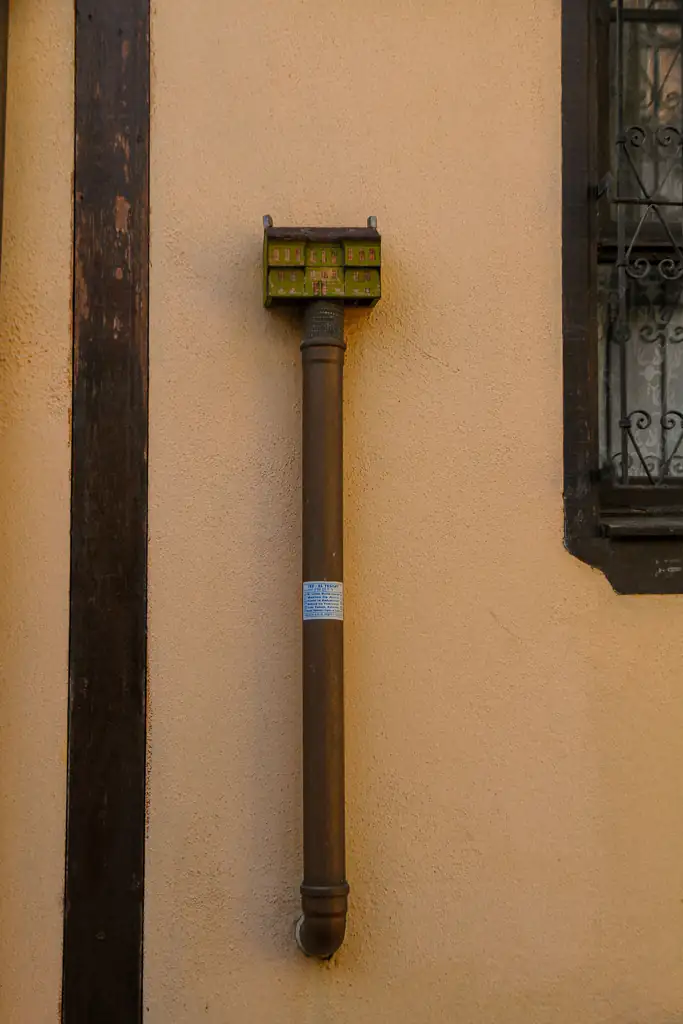
A splash block just disperses water a foot or two from the base of the downspout; a downspout extension carries it several feet farther to where the ground slopes away. Splash blocks are minimal; extensions actually move water off the foundation zone.
When water comes out the bottom of a downspout, you have to do something with it, and the two most common answers are a splash block or a downspout extension. They are not the same tool for the same job. A splash block just disperses water a foot or two from the base of the downspout; an extension carries it several feet farther, out to where the ground slopes away. The block keeps a single spot from eroding. The extension actually moves water off the foundation zone. Which you need comes down to how far your particular yard requires the water to travel before it stops being a problem.
A splash block is a shaped tray or shallow slab — concrete, plastic, or stone — that sits under the downspout outlet. Its job is narrow: catch the falling water, spread it out, and slow it down so it does not carve a hole or channel in one spot. In doing that it nudges the water outward, but only a foot or two. It does not transport water anywhere; it disperses it right where it lands.
A downspout extension is a length of pipe or flexible tubing that attaches to the outlet and carries the water somewhere before releasing it. That is the fundamental difference: the block disperses in place, the extension transports across distance. An extension can be a rigid pipe lying on the surface, a flexible accordion tube, a hinged or roll-out design, or a buried line to a pop-up emitter. Whatever the form, its purpose is reach — getting the discharge out past the soil that sits against the foundation. The full menu of forms is compared in downspout extension options compared.
This is where the comparison is decided, because reach is the whole point of moving downspout water in the first place.
Every downspout dumps a large volume — a single spout can carry hundreds of gallons off the roof in one storm. Release all of that a foot or two from the wall, and it soaks into the backfilled soil that rings the foundation, the very soil most prone to holding water and settling back toward the house. A splash block leaves the water squarely in that zone on most lots. It solves erosion at the outlet, but not the foundation-water problem.
An extension moves the release point out past that backfill zone, onto ground that can absorb or shed the flow. How far is far enough depends on your soil, your grade, and how much roof drains to that spout; a common starting point is at least four to six feet, though that figure is a guideline, not a law. Heavy clay and flat ground push it farther. The details of getting that distance right are in how far downspouts should extend.
Neither device overcomes bad grading. If the ground near the house is flat or slopes back toward it, even a long extension only helps as far as the water can then flow — and a splash block barely helps at all. Extensions and splash blocks manage the water that reaches them; they do not fix a grade that sends water home again. On problem lots, correcting the slope matters as much as choosing the right discharge device.
Neither is universally “better.” They fit different situations.
A splash block alone makes sense when:
A downspout extension is the better choice when:
And frequently the right answer is both together: an extension to carry the water out several feet, with a splash block at its end to disperse the discharge so it does not erode a single spot or channel straight back. They are not really rivals; the block handles the last foot while the extension handles the distance.
| Factor | Splash block | Downspout extension |
|---|---|---|
| Primary job | Disperse water, prevent erosion at the outlet | Carry water away from the foundation |
| Typical reach | A foot or two | Several feet, out past the backfill zone |
| Best yard | Good existing slope, well-draining soil | Flat, clay-heavy, or large roof area |
| Foundation protection | Limited; often leaves water in the zone | Moves the release point off the zone |
| Cost | Minimal | Low above-ground; higher if buried |
| Visibility | Small, low-profile | Visible unless buried; can obstruct mowing |
| Maintenance | Almost none | Keep clear; buried lines can clog unseen |
A splash block and a downspout extension answer the same question — what to do with water leaving the downspout — but they answer it at different scales. The block handles the last foot, dispersing water so it does not erode the ground right at the outlet. The extension handles the distance, carrying water out past the foundation zone to where the yard can take it. On a well-sloped lot with light roof load, a block may be all you need. On flat or clay-heavy ground, or under a large roof, only an extension truly moves the water off the foundation. Match the tool to how far your yard needs the water to go, and pair them when it helps.
FAQ
Sometimes, but often not. A splash block only disperses water a foot or two from the base of the downspout, which frequently leaves it inside the backfill zone right against the house. On a lot with good existing slope it may be enough; on flat or clay-heavy ground it rarely moves water far enough, and an extension does more.
A splash block is a shaped tray or slab under the downspout that spreads and slows the water so it does not erode one spot, nudging it out a foot or two. An extension is a length of pipe or tubing that actually carries the water several feet before releasing it. The block disperses; the extension transports.
Farther than a splash block, typically several feet, out to where the ground slopes away from the house. The right distance depends on your soil, grade, and roof area, and a common starting point is at least four to six feet, though that is a guideline rather than a rule. The goal is to clear the backfill zone next to the foundation.
Yes, and it is common. An extension carries the water out several feet, and a splash block at its end disperses the discharge so it does not erode a single spot or channel back. The two are not really rivals; the block handles the last foot while the extension handles the distance.
Poorly, in most cases. A splash block relies on the ground beyond it already sloping away to carry water off. On a flat lot the water it releases just sits a foot or two from the house and can seep back toward the foundation. Flat and clay-heavy yards are exactly where an extension earns its keep.
Because it only moves water a foot or two, which often is not past the backfilled soil that rings the foundation, and because that soil frequently slopes slightly back toward the house. If the splash block releases water into a low spot or onto ground tilting the wrong way, it simply relocates the puddle. That is a sign you need more reach.
Splash blocks are about as simple and inexpensive as drainage gets, which is much of their appeal. Basic above-ground extensions are also inexpensive, though a little more than a bare block, and buried extensions cost more in materials and labor. Cost is rarely the deciding factor; how far you need to move the water usually is.
Keep reading
Splash blocks vs pop-up emitters — how each disperses roof water, where each fits, and the reach, clogging and freezing tradeoffs that decide between them.
Rain chains vs downspouts — how a rain chain moves water, how its capacity compares, the splash, wind and freeze tradeoffs, and where each one belongs.
Compare downspout extension options — splash blocks, above-ground pipe, hinged and roll-out styles, and buried lines — by reach, upkeep, freezing and looks.