Downspout Extension Options Compared
Compare downspout extension options — splash blocks, above-ground pipe, hinged and roll-out styles, and buried lines — by reach, upkeep, freezing and looks.
Downspouts
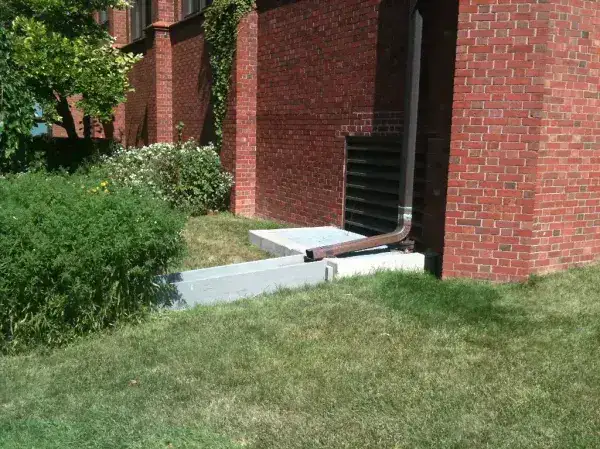
As a general guideline, downspouts should discharge water at least four to six feet from the foundation, onto ground that slopes away. The right distance depends on your soil, grading and how much roof drains to that spout — heavy clay or flat ground calls for more, not less.
A downspout has one job the rest of the gutter system depends on: put the water down somewhere it will leave the house alone. As a general guideline, that means carrying discharge at least four to six feet from the foundation, onto ground that already slopes away — but treat that figure as a starting point, not a law. A spout that dumps runoff right at the wall simply relocates the entire roof’s water to the worst possible spot: against the foundation, where it can soak down alongside the footing and find its way into a basement or crawl space.
Every square foot of roof funnels rain into a handful of downspouts, so a single spout can deliver hundreds of gallons during one storm. Release all of that at the base of the wall and the soil there stays saturated. Saturated soil presses against the foundation (hydrostatic pressure), works into small cracks, and over seasons of wet-then-dry cycling can contribute to settling, efflorescence, and that persistent musty smell downstairs.
Moving the discharge point out a few feet changes the geometry entirely. The water lands where the ground can absorb or shed it, instead of pooling in the narrow trench of backfilled soil that always sits closest to the house — the very soil that tends to settle and slope back toward the wall over time. This is why getting discharge right is one of the highest-value, lowest-cost improvements you can make: it addresses the last step in the path from roof to foundation, and it is the step most often ignored.
Four to six feet is a widely repeated rule of thumb because it clears the backfill zone on a typical lot. It is not a magic number, and for many homes it is not enough. The right distance depends on conditions that vary house to house:
The four-to-six-feet figure is a common guideline, not a guarantee. Soil, slope, and roof size can all push the right distance well beyond it. And where the water ultimately goes matters legally as well as physically: discharging onto a neighbor's property or into the public stormwater system may be regulated or prohibited in your area. Check your local rules before routing water toward a property line, sidewalk, or street.
There is no single best method — the right one depends on your yard, your climate, and how much you care about the extension being visible. Here is how the common options compare:
| Method | Best for | Watch out for |
|---|---|---|
| Splash block | Mild cases, good existing slope | Only redirects a foot or two |
| Above-ground extension | Cheap, easy, movable | Visible; can be a trip or mowing obstacle |
| Hinged / roll-out extension | Keeping paths and patios clear | Needs to be flipped or unrolled before rain |
| Buried pipe to pop-up emitter | A tidy, permanent look | Requires slope; can clog or freeze |
A splash block sits under the spout and nudges water a foot or two out. It is better than nothing where the grade is already good, but on flat or clay-heavy ground it rarely moves water far enough to matter.
An above-ground extension is a length of pipe or flexible tubing that carries water several feet before releasing it. It is the workhorse option: inexpensive, easy to inspect, and simple to reposition. The trade-off is that it lies across the yard, where it can catch a mower or a toe.
A hinged or roll-out extension solves the tripping problem by lifting or retracting when not in use. The catch is that it only works when it is deployed — a roll-out that stays coiled during a storm does nothing.
A buried pipe to a pop-up emitter routes water underground to a small valve that lifts and releases the flow farther out in the yard. It is the tidiest look and keeps the surface clear, but it demands continuous downhill slope, a real outlet the water can escape from, and a plan for clogs and freezing. The details that make or break these systems are covered in underground downspout drainage.
Above-ground extensions
Buried lines to a pop-up emitter
Forget the exact number for a moment. The only test that matters is what happens during and after a real downpour. Put on a raincoat, go outside while it is pouring, and watch each discharge point. Then walk them again once the rain stops.
If water pools where it lands, or worse, trickles back toward the house, the discharge is not far enough or the ground is not cooperating. If it disperses and moves steadily away from the foundation, the distance is working — whatever the tape measure says. This single observation tells you more than any guideline, because it accounts for your specific soil, grade, and roof in a way a generic number never can.
Get the discharge point right and you have handled the step that most often lets roof water reach the foundation. It costs little, needs no special skill, and pays off every time it rains.
FAQ
No. It is a common starting point, not a code requirement. Homes on flat lots, heavy clay soil, or with large roof areas draining to one spout often need water carried farther. The real test is simple — water should not pool or run back toward the foundation after it discharges.
Common options are a splash block, an above-ground extension, a hinged or roll-out extension, or a buried pipe to a pop-up emitter farther out. Above-ground methods are cheapest and easiest to maintain; buried lines are tidier but need to be planned for slope and freezing. There is no single best choice — it depends on the yard.
Yes, and it is a clean solution when done right. Buried downspout drainage needs proper slope, a real outlet the water can escape from, and a plan for clogs and freezing. See our guide to underground downspout drainage for what makes these systems succeed or fail.
Sometimes it is enough, because moving discharge away from the wall removes a major water source. But if grading slopes toward the house or the gutters overflow, the extension only helps with the water that actually reaches it.
Onto ground that slopes away from the house and can absorb or carry the flow — a lawn, a planted bed, or a swale. Avoid aiming it at a walkway, a patio that drains back toward the house, or your neighbor's yard. Where the water goes after it leaves your spout can be regulated, so check local rules before discharging toward a property line or the street.
Maybe, but do not assume it is allowed. Some municipalities require or permit discharge to the public stormwater system; others prohibit connecting to it or draining across sidewalks. Rules vary widely by location, so confirm with your local authority before routing water off your property.
Keep reading
Compare downspout extension options — splash blocks, above-ground pipe, hinged and roll-out styles, and buried lines — by reach, upkeep, freezing and looks.
How to decide where downspouts should go — low ends, corners, spacing, and safe discharge points — while balancing drainage against curb appeal.
How to disconnect a downspout from a buried or sewer line and safely redirect roof water onto the yard — where the water must go, the caveats, and common mistakes.