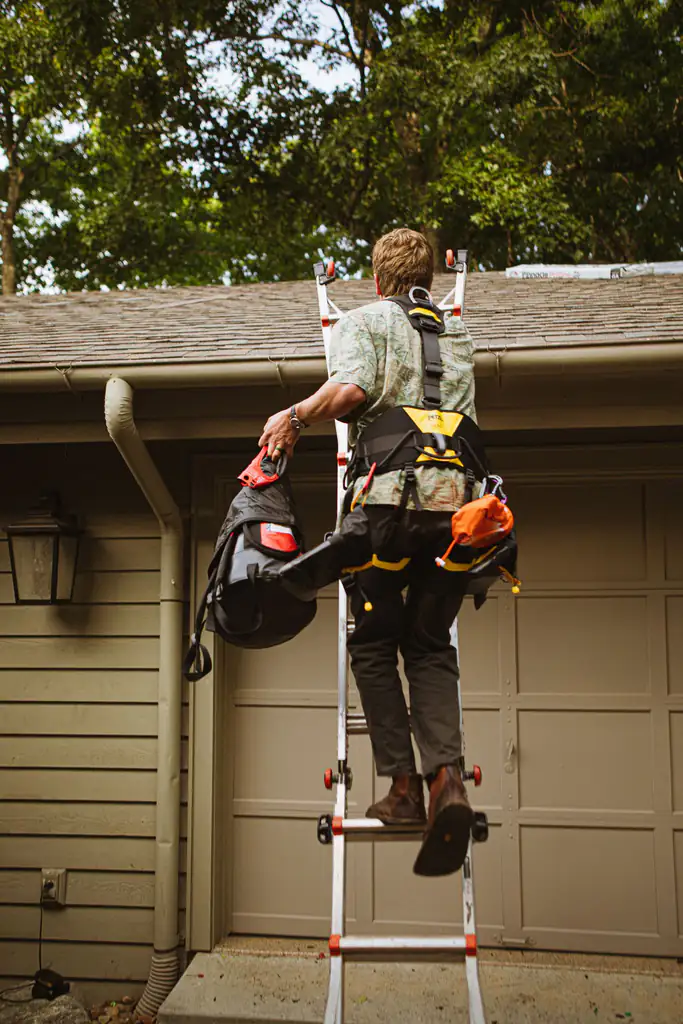
Gutter Cleaning Safety Tips
Practical gutter-cleaning safety — ladder setup and angle, avoiding overreach, working with a partner, staying off wet roofs, and knowing when to hire out.
Seasonal Maintenance

On a two-story home the gutters are out of safe reach for most ladders, which changes the plan — from-the-ground tools, guards to stretch the interval, and hiring out the high work are usually smarter than risking a tall ladder.
Short answer: on a two-story home your gutters sit well above the reach of an ordinary ladder, and that single fact should reshape your whole approach. Instead of muscling a tall extension ladder into place, lean on tools you can use from the ground, add guards to stretch the time between cleanings, and hand the genuinely high work to a professional. It is usually the smarter — and much safer — plan.
Working at height is dangerous. Ladder and roof work risks serious falls, worse on wet or icy surfaces; if you lack safe, stable access, hire a professional.
On a single-story house, a stable step ladder puts the gutter at chest height and a fall means a short drop. A two-story home is a different problem entirely. The gutters may sit 20 feet or more off the ground, which means an extension ladder set at a proper angle, on footing that is rarely as level as you would like. The distance you could fall roughly doubles, and the consequences climb faster than the height does.
That is why copying a single-story routine onto a two-story home tends to go wrong. The task looks the same — scoop the leaves, flush the downspout — but the margin for error has shrunk to almost nothing. The reasonable response is not to be braver on the ladder. It is to change the tools and the plan so that far less of the work happens at height in the first place.
If you want the underlying ladder principles, our gutter cleaning safety tips cover setup, angle, and footing in more detail. Everything there matters more, not less, on a taller home.
A surprising amount of gutter maintenance on a two-story home can be done with both feet planted. None of these tools fully replace a hands-on cleaning, but together they let you monitor, rinse, and clear light debris without a tall ladder.
Our guide to inspecting gutters from the ground walks through what to look for during dry weather and in the rain, which pairs naturally with the tools above.
Ground tools are best thought of as maintenance and monitoring, not deep cleaning. When a gutter is heavily packed or draining poorly, a pole and a hose often just move the problem around. That is the point where a proper hands-on clearing — usually by someone equipped for the height — becomes the right call.
Because getting to a two-story gutter is the hard part, anything that reduces how often you need to is worth serious consideration. Gutter guards — screens, micro-mesh, or reverse-curve covers — do not eliminate maintenance, but they can meaningfully cut how much debris settles and packs in.
The value proposition changes with height. On a single-story home, guards are a convenience. On a two-story home, they can turn three or four access events a year into one, which is a genuine safety improvement, not just a time saver. They still need occasional rinsing and inspection, and no guard is truly maintenance-free, so treat the marketing claims with a healthy dose of skepticism.
For the genuinely high, hands-on cleaning, hiring a professional is often the most sensible option on a two-story home — not a failure of self-reliance. Professionals bring taller ladders, sometimes stabilizers or lifts, and the habit of working at height. Our comparison of DIY versus professional gutter cleaning lays out the trade-offs; on a tall home the safety side of that ledger simply weighs more.
A reasonable hybrid many owners settle into: do the ground-level monitoring and light rinsing yourself, and bring in a pro once or twice a year for the thorough clearing. That keeps you engaged with your home’s drainage without putting you on a tall ladder.
| Approach | Best for | Reaches 2nd story? | Main limitation |
|---|---|---|---|
| Ground wand / pole | Light, loose debris; rinsing | Yes, with reach | Struggles with packed sludge |
| Binocular inspection | Spotting problems early | Yes | Look only, no clearing |
| Gutter guards | Reducing cleaning frequency | N/A (installed) | Still needs periodic care |
| Tall extension ladder (DIY) | Hands-on clearing | Yes | High fall risk; needs safe footing |
| Professional service | Thorough clearing at height | Yes | Recurring cost |
The core insight for a two-story home is that reach, not effort, is the real constraint. Once you accept that the high work is genuinely hazardous, the smart plan almost writes itself: monitor and rinse from the ground, install guards to cut how often anyone needs to be up there, and hire out the hands-on cleaning when it is truly out of safe reach. That approach keeps your gutters working and keeps you off a ladder that was never worth the risk.
FAQ
Sometimes, but the height raises the stakes a lot. A tall extension ladder on uneven ground is far less forgiving than a short step ladder, and a fall from the second story is often serious. If you do not have safe, stable, level access and someone to foot the ladder, this is the classic case for hiring out.
Telescoping gutter wands that attach to a hose or leaf blower, extension poles with scoop or brush heads, and ground-viewing checks with binoculars all help. They are best for light debris and monitoring rather than heavy, packed clogs, but they keep you on solid ground.
No. Guards can dramatically reduce how often you clear debris, which matters most on a two-story home, but they still need occasional inspection and rinsing. Think of them as stretching the interval, not eliminating maintenance.
The same general cadence as any home — roughly twice a year plus after big storms — but because access is harder, many owners lean on ground inspection between professional visits. Trees nearby will push the frequency up.
A taller ladder lowers the equipment cost but raises the risk cost. The danger of second-story ladder work is not really about the ladder price; it is about the fall distance and setup. Weigh that honestly before deciding.
During rain, watch for water sheeting over the front edge, spilling at seams, or streaking down the siding. From the ground on a dry day, binoculars can reveal sagging sections, plant growth, or debris humps sticking above the gutter line.
If a professional is already set up at height, it is reasonable to ask them to note obvious roof issues while they work. But do not add your own roof walk as a reason to climb — that stacks two high-risk tasks into one.
Keep reading
Practical gutter-cleaning safety — ladder setup and angle, avoiding overreach, working with a partner, staying off wet roofs, and knowing when to hire out.
The gutter-cleaning mistakes that cause falls, missed clogs, and repeat work — from overreaching on a ladder to ignoring downspouts and rushing the job.
How to inspect your gutters from the ground — what to watch for in the rain and in dry weather, which tools help, and when you genuinely need to go up.