Cleaning Gutters After a Storm
A quick post-storm gutter check for US homeowners — spot overflow from the ground, clear the outlets, and confirm the downspouts run before the next rain arrives.
Seasonal Maintenance

Flushing is the finishing step, not the whole job — scoop the bulk of debris out first, then run the hose along the trough toward each downspout and watch that the outlet flow matches what you put in. Flushing a full gutter just packs a wet plug into the downspout.
Flushing gutters with a hose is the last step in a cleaning, not the whole job. Scoop the bulk of the debris out first, then run water along the trough toward each downspout, and confirm the outlet drains at full flow. Done in that order, a hose clears fine grit and reveals hidden problems. Done in the wrong order — hose first, on a full gutter — it packs a wet plug straight into the downspout.
Here is how to do it so the water works for you instead of against you.
A gutter full of leaves is not a candidate for flushing. Water turns dry, liftable debris into heavy sludge that slides toward the nearest outlet and jams it. Clearing that clog is a far worse job than the cleaning you started with. So the rule is simple: scoop first, flush second. If you have not cleared the bulk yet, start with our step-by-step gutter cleaning method and come back to the hose once the trough is mostly empty.
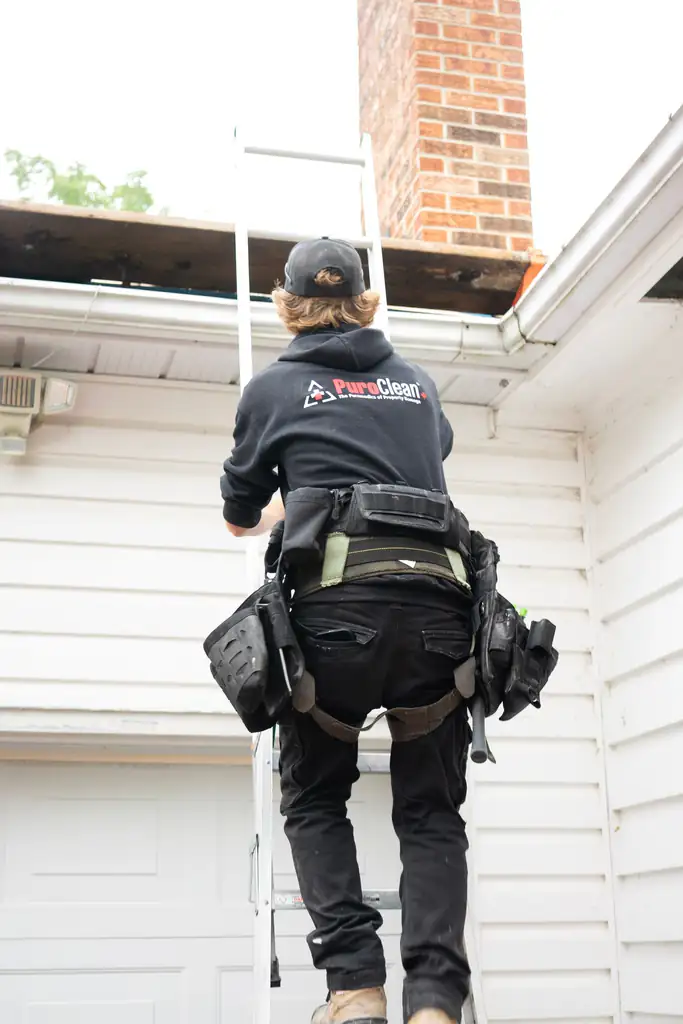
Working at height is dangerous. Flushing tempts you to lean and follow the water with the nozzle. Keep your hips between the ladder rails, move the ladder rather than reaching, and never work on a wet or icy roof edge. If safe access is not possible, hire a professional.
Position yourself at the high end of the run — the end farthest from the outlet — so the water carries debris toward the exit rather than away from it. If a run has a downspout at each end, work from the middle outward toward each one.
Set the nozzle to a firm, steady stream and aim it along the bottom of the trough, walking the water toward the downspout. Moderate pressure is all you need. Very high pressure splashes grit under the shingles or behind the fascia and tempts you to stretch after the spray. Let the flow, not the force, move the debris.
As you rinse, watch the water behavior. A trough that drains steadily is doing its job. Water that pools in a section points to a problem: a low spot, a sagging run that has lost its pitch, or an outlet that is not yet clear. Note where it pools — that is where to look next.
This is the step people skip, and it is the one that decides whether the gutter actually works. Feed the hose into the top of the downspout and walk down to watch the bottom outlet.
| What you see at the outlet | What it means |
|---|---|
| Full, steady stream matching the input | Downspout is clear |
| Weak trickle | Partial clog inside the pipe |
| Backup at the top, little at the bottom | Full blockage |
| Water leaking from a joint | Separated or failed seam in the downspout |
If the outlet does not run clear, the gutter will overflow no matter how clean the trough looks. Treat the downspout as its own task.
If an outlet trickles or backs up, work the downspout directly. Tap along its length to loosen a plug, run the hose from the bottom outlet upward, or feed a plumber’s snake down from the top. Our guide on how to unclog a downspout walks through each method and when to use it. Only call the flush finished when every downspout drains at full flow.
Curved wand attachments let you rinse the trough from the ground or a low rung, which is genuinely safer on two-story runs. Their limit is that they are a maintenance rinse, not a scooping tool — they work on gutters that are already mostly clear, not on a trough packed with wet leaves. Used that way, they are a useful part of the toolkit. For the fuller range of options, see our overview of gutter cleaning tools and methods.
Every roofline is different. Gutter height, pitch, and the condition of your downspouts all change what a hose can and cannot do safely. Treat this method as a general guide, not a substitute for judging your own situation.
Flushing is simple once the order is right: clear the bulk by hand, rinse each run toward its outlet with a firm steady stream, and confirm the water comes out the bottom of every downspout as fast as it goes in. That last check is what separates a gutter that looks clean from one that actually is. Respect the height, keep the pressure moderate, and let the water do the fine work.
FAQ
After. Remove the bulk of leaves and grit by hand first, then flush. Spraying water into a full trough turns loose debris into a wet plug that jams the downspout, which is far harder to clear than an open gutter.
A basic adjustable nozzle set to a firm stream covers most jobs. Some homeowners use a curved gutter-cleaning wand to reach the trough from a lower ladder position, but a standard nozzle and a steady stream are usually enough.
Feed the hose into the top of the downspout and watch the bottom outlet. A full, steady stream that roughly matches the water going in means it is clear. A trickle or a backup at the top points to a clog inside the pipe.
Pooling usually means a low spot, a sagging section, or a downspout that is not yet clear. Check the nearest outlet first; if it drains fine, the trough itself may have lost its slope and need re-pitching.
There are wand attachments that let you rinse from the ground or a lower rung, which is safer on tall runs. They work best as a maintenance rinse on gutters that are already mostly clear, not as a substitute for scooping out packed debris.
A firm garden-hose stream is plenty. Very high pressure is unnecessary, can splash debris under shingles or behind the fascia, and tempts you to reach or lean. Steady, moderate flow aimed toward the outlet does the work.
Yes. If the outlet trickles, work the downspout on its own — tap along its length, run the hose from the bottom up, or use a plumber's snake. Trying to clear a downspout clog only from the top with the trough full rarely works.
Keep reading
A quick post-storm gutter check for US homeowners — spot overflow from the ground, clear the outlets, and confirm the downspouts run before the next rain arrives.
How to clean an underground downspout drain: flush from the inlet, clear the outlet, run a drain snake, and recognize when a buried line needs repair instead.
A plain, step-by-step method for cleaning your gutters safely: set up, scoop, flush, and confirm each downspout runs clear.