Oversized Downspouts Explained
When upsizing to larger downspouts like 3x4 actually helps, why the gutter outlet has to match, and how to avoid simply relocating the bottleneck.
Downspouts

Downspout size and count decide whether a gutter can actually empty. Common residential downspouts are 2x3-inch and larger 3x4-inch rectangular, plus round profiles; bigger or steeper roofs and longer gutter runs need larger or additional downspouts, not just wider gutters.
A downspout is the outlet for your gutters, and its size and count decide whether the system can actually empty. Common residential downspouts are 2x3-inch and 3x4-inch rectangular, plus round profiles in 3-inch and 4-inch. Bigger or steeper roofs and longer gutter runs need larger or additional downspouts, not just wider gutters.
It is an easy thing to overlook. Most people picture the gutter as the part that matters and treat the downspout as a plain drainpipe bolted to the corner. But the gutter only collects water. The downspout is what carries it away, and if that outlet is too small or there are too few of them, everything upstream backs up.
Rain hits the roof, sheets down into the gutter, and travels along the trough toward the nearest outlet. That outlet feeds the downspout. If water arrives faster than the downspout can take it, the gutter fills, reaches the front edge, and spills over.
This is why the downspout is best understood as the bottleneck. A gutter can be perfectly sized, pitched, and clean, and still overflow simply because the outlets cannot move water fast enough. Understanding the whole path helps here, and our overview of how gutters work walks through the trough-to-outlet handoff in more detail.
The practical takeaway: when you think about drainage capacity, think about the downspouts first.
Residential downspouts come in a handful of standard shapes and sizes. Rectangular styles dominate because they pair cleanly with K-style gutters and sit flat against a wall. Round profiles show up on half-round gutters and on homes going for a particular look.
| Profile | Nominal size | Typical pairing | General use |
|---|---|---|---|
| Rectangular | 2x3 in | 5-in K-style gutter | Standard homes, moderate roof areas |
| Rectangular | 3x4 in | 6-in K-style gutter | Larger or steeper roofs, long runs, heavy-rain regions |
| Round (smooth) | 3 in | Half-round gutter | Traditional and historic looks, good debris flow |
| Round (smooth) | 4 in | Half-round or large gutter | Bigger roofs wanting a round profile |
| Round (corrugated) | 3-4 in | Utility and outbuildings | Budget runs, more flow restriction |
The jump from 2x3 to 3x4 is bigger than the numbers suggest, because capacity scales with cross-sectional area rather than with any single dimension. A 3x4 has a much larger opening than a 2x3, so it both carries more water and lets leaves and grit pass instead of jamming.
These are general norms, not code minimums. The right size for your house depends on roof area, local rainfall intensity, and what your local building code requires. Treat the pairings above as a starting point, not a guarantee.
Neither profile is universally better. The choice usually comes down to the gutter style you already have, the look you want, and how much debris your roof sheds.
Downspout capacity is not a single fixed number. It comes from the interaction of three things: how much roof drains into a given gutter run, how hard it can rain where you live, and how many downspouts serve that run.
The general principles are straightforward:
That last point is the one homeowners miss most often. Adding a second outlet to a long run frequently solves overflow better than any other single change, because it halves the distance water has to travel before it can leave the gutter.
Formal sizing uses roof drainage area and a local rainfall-intensity figure from code tables. If you are near the edge of overflowing, or planning new construction, have the numbers run against your local code rather than relying on rules of thumb.
A widely repeated guideline is roughly one downspout for every 30 to 40 feet of gutter. It is a useful sanity check, but it is only guidance.
The reason it varies so much: 40 feet of gutter draining a small, low-slope roof in a mild climate is a very different load from 40 feet draining a large, steep roof in a region with intense summer storms. The same length of trough can call for very different outlet counts depending on conditions.
Use the rule to spot obvious problems, such as a 60-foot run with a single downspout, then let roof area and rainfall guide the final count.
An undersized outlet has a telltale signature. The system works most of the time and fails only when it rains hard.
If any of these sound familiar, the outlet is a likely culprit. Our guide to why gutters overflow in heavy rain covers how to tell an undersized downspout apart from a clog or a pitch problem, since the fixes are different.
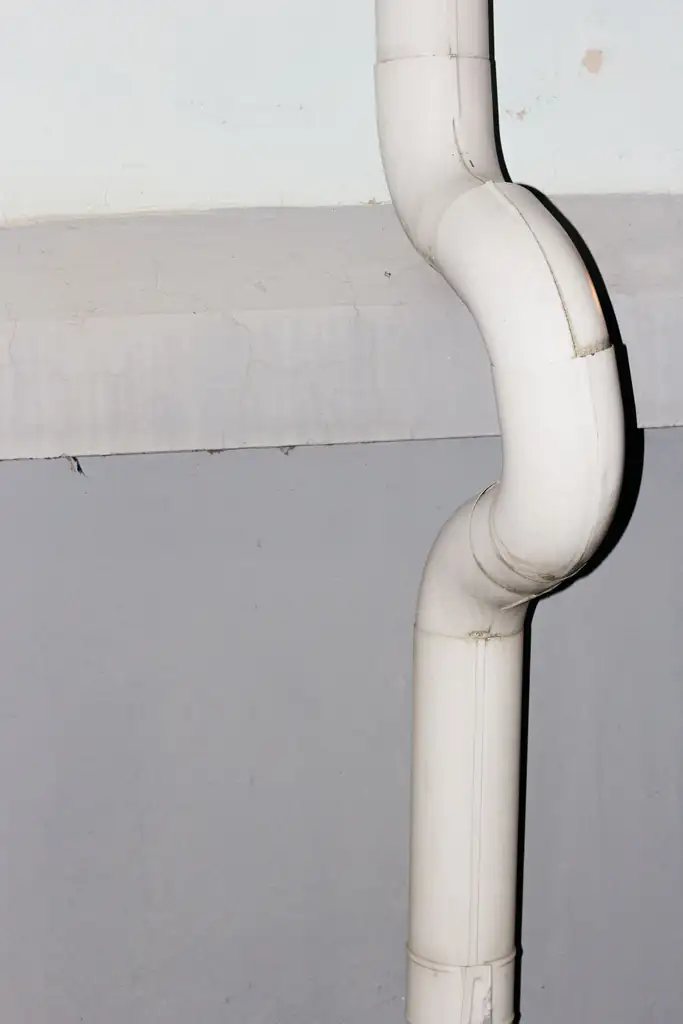
A downspout run is more than the vertical pipe. Elbows redirect it around eaves and foundations, and straps or brackets hold it against the wall so wind and the weight of moving water do not loosen it.
Two practical notes:
Where the water goes after it exits the bottom elbow matters just as much as the pipe itself. If it dumps at the foundation, you have traded a gutter problem for a basement one. See how far downspouts should extend for getting discharge safely away from the house.
The downspout is the outlet, and the outlet decides whether your gutters can empty. Start with the common sizes, 2x3 and 3x4 rectangular or round 3-inch and 4-inch, then let roof area, rainfall intensity, and gutter length tell you whether you need a larger profile, more outlets, or both. When in doubt, more or larger downspouts almost always beats a wider gutter alone.
FAQ
The 2x3-inch rectangular downspout is the most common on standard 5-inch K-style gutters. On larger roofs, longer gutter runs, or 6-inch gutters, the wider 3x4-inch downspout is a frequent upgrade because it moves noticeably more water and clogs less often.
A 3x4 downspout has a substantially larger cross-section than a 2x3, so it carries more water and passes debris more easily. It is the better choice on big or steep roofs and long gutter runs, though it costs a little more and is more visible against the wall.
A common rule of thumb is roughly one downspout for every 30 to 40 feet of gutter, but this is only general guidance. The real answer depends on roof area, rainfall intensity, downspout size, and local code, so heavy-rain regions and large roofs often need outlets spaced more closely.
Round downspouts, especially smooth round profiles used on half-round gutters, actually tend to resist clogging well because they have no sharp corners for debris to catch. Corrugated round pipe is more restrictive. Rectangular downspouts are more common mainly for cost and appearance, not superior flow.
The clearest sign is overflow that only happens during heavy downpours while the gutter drains fine in light rain. Water pooling or backing up at the outlet, and gutters that stay full long after the rain stops, also point to an outlet that cannot keep up.
Wider gutters hold more water but do not drain faster on their own. The downspout is the outlet and the bottleneck, so a wider gutter with too few or undersized downspouts will still overflow. Adding outlets or upsizing them is usually more effective than widening the trough alone.
Elbows and straps are matched to the downspout profile, so a 2x3 downspout uses 2x3 elbows and brackets and a 3x4 uses 3x4. Mixing sizes creates leaks and weak joints, so keep the whole run in one consistent size and material.
Keep reading
When upsizing to larger downspouts like 3x4 actually helps, why the gutter outlet has to match, and how to avoid simply relocating the bottleneck.
How many downspouts a house needs — the 30-to-40-foot rule of thumb, what changes it, signs a long run needs another outlet, and the mistakes that leave gutters overflowing.
Why a downspout backs up only in heavy rain — how to tell a capacity problem from a partial clog, and the fixes that actually keep water moving when it pours.