Channel Drains and Trench Drains
What a channel or trench drain is, where it beats a single spot drain, and how slope, grate choice and a real outlet decide whether it works. Uses and common mistakes.
Drainage

Driveways and patios shed rain onto whatever is beside them — often a strip of lawn or the foundation. Channel (trench) drains along the edge, correct slope, and permeable surfaces move that water to a safe outlet instead of pooling or running toward the house.
Driveways and patios do not absorb rain — they shed all of it, fast, onto whatever sits beside them. Too often that is a strip of lawn that cannot keep up or, worse, the foundation. Channel drains along the edge, correct slope, and permeable surfaces are the tools that catch that concentrated runoff and send it to a safe outlet instead of letting it pool or run toward the house.
A patch of bare lawn is a sponge. Rain lands on it and most soaks in where it falls, spread out over the whole surface and over time. Pave that same patch and everything changes: the water cannot penetrate, so every drop runs off the surface, all at once, heading downhill to the lowest edge. A driveway can gather the rain from a large area and deliver it, concentrated, to a single strip a few feet wide.
That strip is usually one of two places, and both are trouble:
The whole task of driveway and patio drainage is to intercept that concentrated flow before it does damage and route it somewhere it can go safely.
Four moves, usually in combination, handle hardscape runoff.
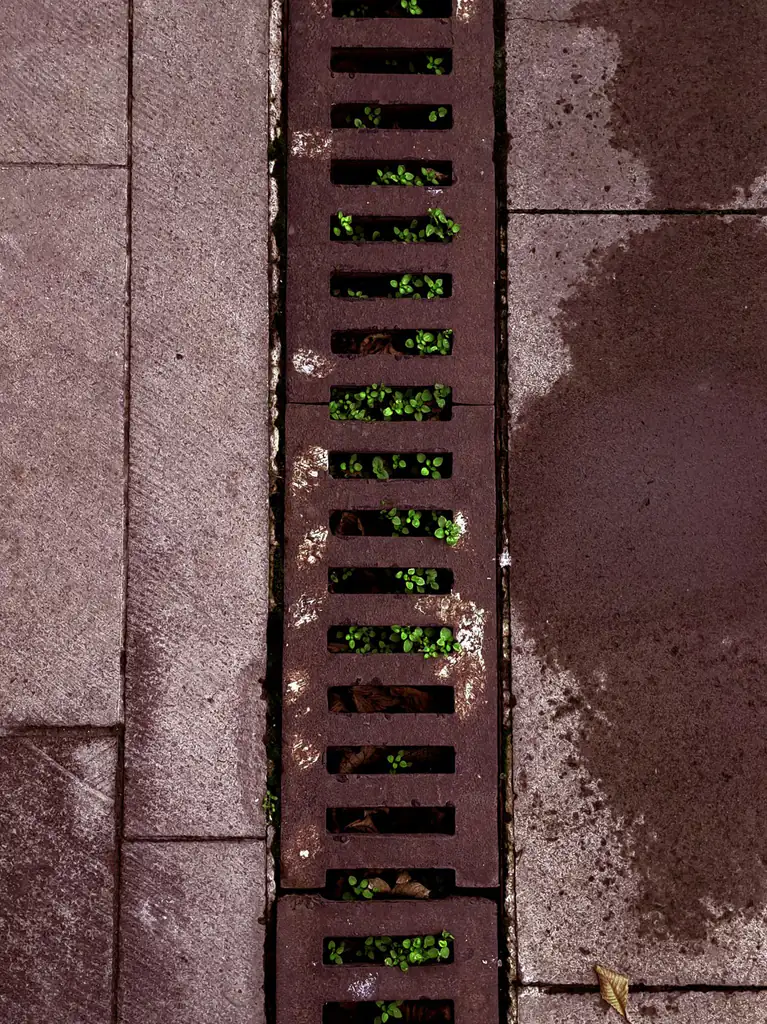
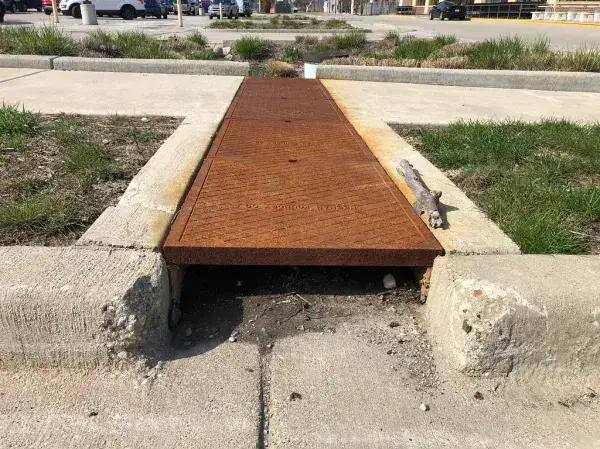
The signature tool for paving. A channel drain is a long, narrow drain with a grate set flush into the surface, so it collects water along its entire length rather than at one point. That linear catch matches the way water comes off paving — as a wide sheet reaching the low edge all along it, not a single stream. Set one across the bottom of a sloped driveway, along the downhill edge of a patio, or right where the drive meets the garage apron, and it intercepts the sheet before it crosses onto lawn or foundation.
Because it collects a whole edge at once, a channel drain differs from a point-collection catch basin, which suits a single spot where water converges. On paving, the linear form usually wins.
Even the best drain fails if the paving tilts the wrong way. The surface should carry water toward the drain or the safe edge and never back toward the house. The exact amount of fall depends on the surface material, the layout, and where the water has to end up — there is no universal number — but the direction is non-negotiable: away from the structure, toward the outlet.
Permeable pavers and porous paving attack the problem at its source by letting water soak through the surface instead of running off it. Less runoff means less to collect and redirect. The catch is that they depend on the base and the soil beneath draining well; over heavy clay their advantage shrinks, and they may still need an underdrain or outlet.
Whatever the drain collects has to go somewhere lower that can accept it — daylight on a slope, a dry well in draining soil, or a storm connection where permitted. This is the same rule that governs every drainage method, and it is covered below because it is the one people forget.
Slope figures for paving depend on the material and the design, so be wary of any single "correct" number. What is fixed is the direction — water must never be pitched back toward the house. Confirm the specifics against your layout and local practice rather than a rule of thumb.
| Tool | Best for | Keep in mind |
|---|---|---|
| Channel / trench drain | Intercepting the wide sheet at a paving edge | Needs an outlet; grate collects debris and needs cleaning |
| Correct slope | Every paved surface, always | Direction matters more than an exact number; never toward the house |
| Permeable pavers | Reducing runoff at the source | Depend on base and soil draining; weaker over clay |
| Piped outlet | Carrying collected water away | Must reach a real, lower discharge point |
Paving turns gentle, absorbed rainfall into a fast, concentrated sheet aimed at whatever is downhill. The fix is to catch that sheet where it leaves the surface — usually with a channel drain across the low edge — pitch the paving away from the house, reduce runoff with permeable surfaces where the soil allows, and pipe what you collect to a genuine, lower outlet. Do that and the driveway sheds its water on your terms instead of the foundation’s.
FAQ
Paved surfaces do not absorb water, so all the rain that lands on them runs off at once toward the lowest edge. That concentrated flow lands on whatever is beside the paving — often a lawn strip or, worse, the foundation — in volumes that bare ground would have soaked up gradually.
A channel drain, also called a trench drain, is a long narrow drain with a grate set flush into the paving surface. Instead of catching water at a single point, it collects it along its whole length, which suits the wide sheet of water that runs off a driveway or patio.
Across the low edge of the paving, where the runoff naturally heads — commonly at the bottom of a sloped driveway or along the downhill side of a patio, and often just before the water would otherwise reach the house or the garage.
Not entirely. Permeable surfaces let water soak through rather than running off, which reduces the problem at the source, but they depend on the base and soil beneath draining well. In poor soil they can still need an outlet or underdrain.
Enough to move water to the edge or drain without pooling, but the right amount depends on the surface, the layout, and where the water needs to go. There is no single correct figure. The goal is that water leaves the surface toward a safe outlet, never toward the house.
Yes. Like any drain, it only collects and redirects water — it has to pipe to somewhere lower that can accept the flow. A channel drain that fills faster than its outlet can carry water away will back up and overflow across the paving.
Sometimes, but not always. Discharge to the street or a public system can be regulated and may require permission. Check your local rules before routing driveway runoff off your property.
Keep reading
What a channel or trench drain is, where it beats a single spot drain, and how slope, grate choice and a real outlet decide whether it works. Uses and common mistakes.
A channel drain catches surface water on paving; a French drain collects saturated water from soil. Here is how to tell which your site actually needs.
Roof water, ground slope, and a real outlet decide whether water stays away from your house. A practical order for tackling water near the foundation.