French Drain vs Catch Basin — Which Do You Need?
A French drain collects soggy subsurface water; a catch basin captures standing surface water. Here is how to tell which one your yard actually needs.
Drainage
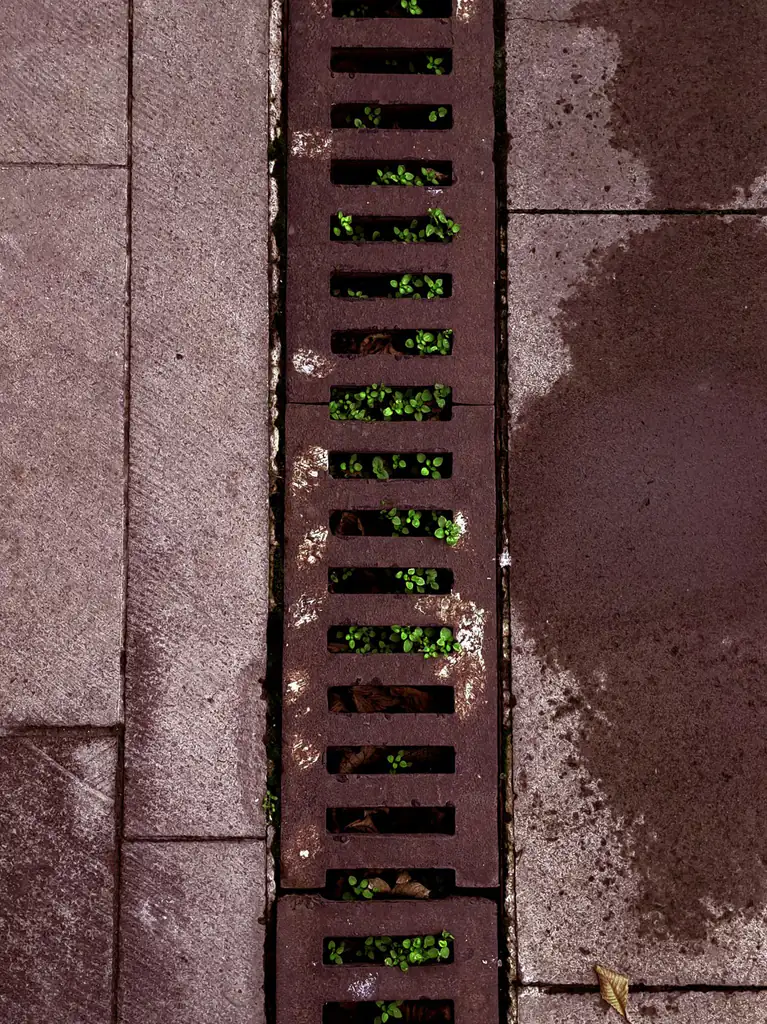
A channel drain is a long surface grate that swallows sheet water running across a hard surface like a driveway or patio. A French drain is a buried gravel trench with perforated pipe that pulls water out of saturated soil. One catches water on top; the other collects it underground.
Short answer: if water is running across a hard surface — a driveway, patio, pool deck, or the apron in front of a garage — and you need to stop it before it reaches somewhere it should not, you want a channel drain. If the ground itself stays wet, soft, and saturated, you want a French drain. A channel drain intercepts water on top of a surface; a French drain collects water out of the soil. They look nothing alike and they solve different problems, yet homeowners reach for the wrong one constantly.
The confusion is understandable. Both are “linear drains” that end in buried pipe and both get installed in a trench. But where they catch the water — above ground or below it — decides which one actually fixes your site.
The distinction is all about where the water is at the moment you capture it.
A channel drain (also called a trench drain or linear drain) is a long, narrow channel with a grate on top, set flush into a paved surface. Water sheeting across the paving hits the grate, drops into the trough, and runs along the built-in slope of the channel to an outlet pipe. It intercepts a wide band of surface flow in a single line rather than at one point. That is why it belongs at the edge of driveways, patios, and thresholds where sheet water needs to be stopped. For the deeper mechanics, see how channel and trench drains work.
A French drain works below the surface. It is a trench lined with filter fabric and filled with gravel, holding a perforated pipe near the bottom. Water sitting in the surrounding soil seeps into the gravel, drops through the pipe perforations, and flows along the pipe to an outlet. It collects along its entire length, not at a single grate, which is precisely why it is the tool for saturated ground. Our guide to planning a French drain walks through the layout.
The right choice depends on your site. Surface material, soil type, slope, roof runoff, and local climate all shape which system fits and how it must be built. Treat what follows as a way to diagnose the problem, not as fixed specifications to copy.
Before choosing hardware, name the problem. Nearly every case is one of two things.
If you cannot tell which you have, our overview of surface vs subsurface drainage is the place to start, because the wrong tool simply will not touch the other kind of water.
| Channel drain | French drain | |
|---|---|---|
| Captures | Surface water on paving | Subsurface water in soil |
| Form | Grated trough set flush in a hard surface | Gravel-filled trench with perforated pipe |
| Collects along | A line across the surface | Its whole buried length |
| Best for | Driveways, patios, thresholds | Soggy lawn, high water table, seepage |
| Outlet pipe | Solid | Perforated in the drain, solid to the outlet |
| Main clog risk | Leaves and grit on the grate; silt in the trough | Silt and roots clogging fabric and gravel |
| Maintenance | Visible and serviceable | Buried and largely unserviceable |
| Needs a real outlet | Yes | Yes |
Neither is magic, and each fails in its own way.
A channel drain does nothing for saturated soil. It only catches water that runs across its grate, so a spongy lawn between low points stays wet no matter how many channels you set in the driveway. It also depends on being installed dead flush and correctly sloped inside the channel; set it a fraction high and water skims past instead of dropping in.
A French drain, in turn, does little on impermeable paving. Water sheeting across a driveway runs off rather than soaking down to the pipe, so a French drain sits idle while the surface floods. And because it is buried gravel and fabric, a French drain is very hard to service once silt eventually works into it — it is generally built to last for years and then be rebuilt rather than cleaned.
Costs vary too much by site to quote real numbers, but the factors are predictable. A channel drain means cutting into and re-setting a hard surface — often the fussiest part, since the grate has to finish flush and the trough has to slope correctly. A French drain means trenching along a whole run in soil, plus gravel, filter fabric, and perforated pipe for the full length. What drives either cost is length, depth, the surface or soil involved, site access, and how far away a usable outlet sits.
Climate matters for both. In freezing regions, any grate, trough, or line holding standing water can ice up and block, and a frozen outlet stops everything upstream. Burial depth and slope have to account for local frost — there is no universal number that works everywhere, so let your site and local code guide the specifics. Both also depend on a real outlet; neither makes water vanish.
Most “which one” debates dissolve once you realize you do not always have to choose. A channel drain can capture surface runoff at a paved apron while a French drain handles a saturated stretch of yard nearby, with both feeding a single solid line to the outlet. On a property with a sloped driveway that also has a wet back lawn, using both is the honest answer. If a driveway or patio is the trouble spot, our guide to driveway and patio drainage covers that side in more detail.
Put the decision in one line: water running across paving → channel drain; saturated soil along a stretch → French drain; both problems → both, tied to one outlet.
Walk the property during and just after a heavy rain and watch what the water does. If it sheets across a hard surface toward the house or garage, a channel drain at that edge is your answer. If the ground simply stays wet and spongy for days with nothing to point at, the water is in the soil and a French drain is the tool. When you see both, plan for both — and make sure whatever you build reaches an outlet where the water can truly leave. For the bigger picture, start with our drainage overview.
FAQ
A channel drain is a long, narrow grated trough set flush into a hard surface that intercepts water flowing across the top of it. A French drain is a gravel-filled trench with a perforated pipe buried in soil that collects water seeping through the ground. One is a surface interceptor; the other is a subsurface collector.
No. A channel drain only catches water that runs across its grate, so it does nothing for ground that is saturated between low points. A spongy, wet lawn is a subsurface problem, which is what a French drain is designed to handle. They solve different problems.
Almost always a channel drain. A driveway sheds water fast across a hard, impermeable surface, and a linear grate set at the low edge catches that sheet flow before it reaches a garage or the house. A French drain does little on paving because water runs off rather than soaking in.
Yes. Neither makes water disappear. A channel drain pipes captured surface water to an outlet, and a French drain pipes collected subsurface water to one. Both fail if that outlet cannot actually release water somewhere lower or into a soakaway that drains.
Yes, and it is common on complex sites. A channel drain can capture runoff at a paved apron while a French drain handles a saturated section of yard nearby, with both tied into a single solid line to the outlet.
A channel drain, because you can see it. You lift or clear the grate, scoop out silt, and flush the run. A French drain is buried and largely unserviceable, so it is built to last and eventually rebuilt rather than cleaned.
They can. Any grate, trough, or line holding standing water can ice up and block, and a frozen outlet stops the whole system. Slope, burial depth, and outlet design all have to account for local frost rather than a single universal rule.
Keep reading
A French drain collects soggy subsurface water; a catch basin captures standing surface water. Here is how to tell which one your yard actually needs.
A French drain collects and moves water; a dry well stores and soaks it into the ground. Here is how to tell which one your yard actually needs.
The outlet decides whether a French drain works. Daylighting, pop-up emitters, and dry wells compared, plus where you must never send the water.