Driveway and Patio Drainage
Why paved surfaces concentrate runoff, and how channel drains, slope, and permeable surfaces route it to a safe outlet instead of toward your foundation. Uses and common mistakes.
Drainage
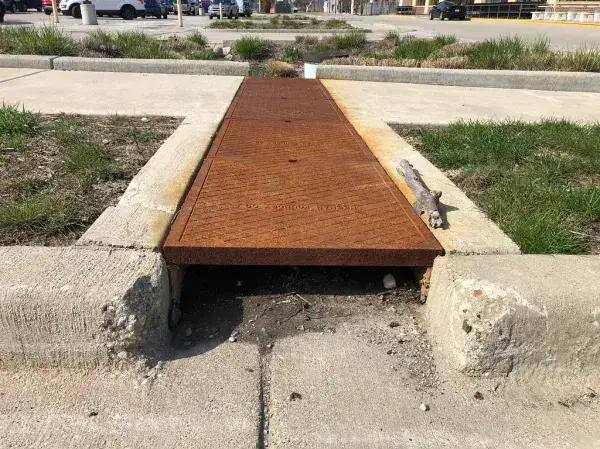
A channel (trench) drain is a long, narrow grated drain set flush with a surface to catch water sheeting off a driveway, patio or garage apron. It intercepts a whole line of runoff at once and pipes it to an outlet, where a single spot drain would be overwhelmed.
Some drainage problems arrive at a single point, and some arrive as a wide, flat sheet. A channel drain is the tool for the second kind. If you have watched a driveway or patio shed a whole edge of runoff at once during a storm, you have seen why a single drain in the middle of it never keeps up.
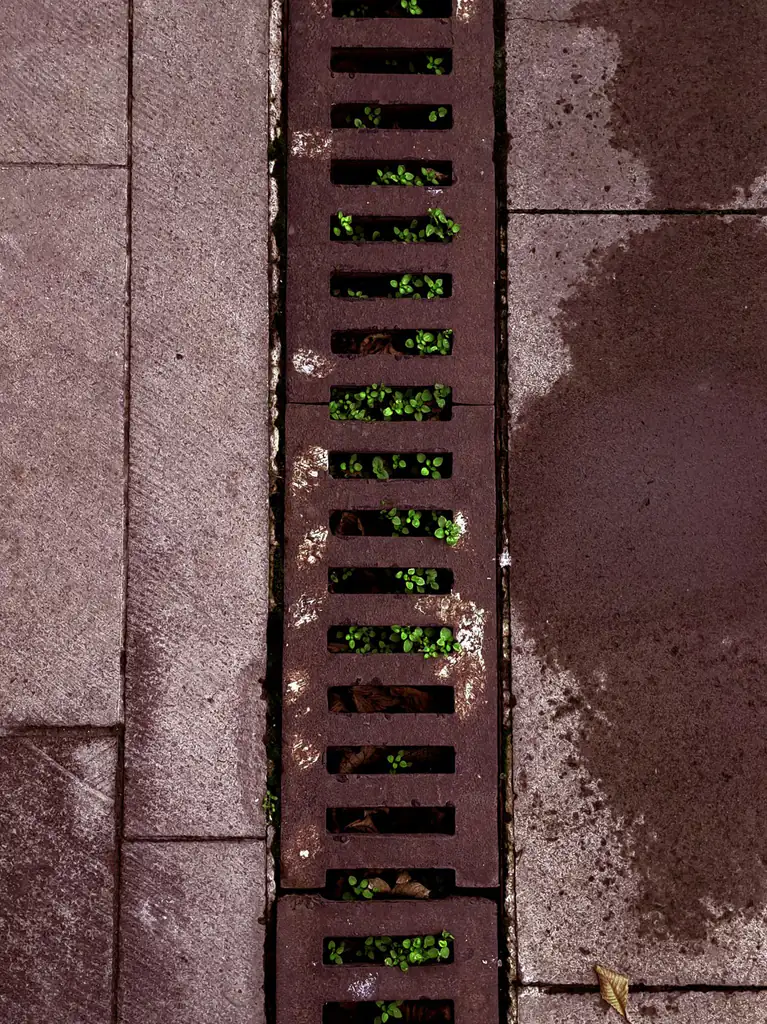
A channel drain — also called a trench drain — is a long, narrow drainage channel with a grate set flush into a paved surface. It catches water sheeting off a driveway, patio or garage apron along its entire length and pipes that water to an outlet. Where a single spot drain would be swamped by a wide sheet of runoff, a channel intercepts the whole line at once. Like every drain, it only works if it pitches to a real, lower place for the water to go.
Paving does not absorb water. Rain that lands on a driveway or patio runs off the surface all at once, heading downhill to the lowest edge as a broad, shallow sheet. That is the key fact: the water does not gather into a single stream you can catch with one drain. It reaches the low edge spread out along its whole width.
A spot drain — a single grated inlet, like a catch basin — is built for the opposite situation, where the ground funnels water toward one low point. Drop that same spot drain across a wide paved sheet and most of the water simply runs past it on either side. It catches a slice and the rest keeps going.
A channel drain matches the geometry of the problem. Set across the low edge of the paving, it presents a continuous opening that collects the sheet along its entire length. Nothing runs past the ends because the channel spans the whole path the water takes. That is why, on driveways and patios, the linear form usually wins — a subject covered more broadly in our guide to driveway and patio drainage.
Three things decide whether a channel drain actually performs.
Slope matters in two directions. First, the paved surface has to pitch toward the channel so water reaches it rather than pooling short of it or running past. Second, the channel itself and the pipe leading away from it have to fall toward the outlet so collected water keeps moving instead of standing in the trench. Some channel systems are built with a slight built-in fall along their length to help this along; others rely on the outlet pipe.
The exact amount of fall depends on the surface, the run length and where the water has to end up, so be wary of any single “correct” number. What is fixed is direction: toward the channel, then toward the outlet, and never back toward the house.
The grate is the visible part and it does real work. It has to bear whatever crosses it — a driveway grate must be rated for vehicle loads, while a patio can use a lighter decorative one — and it filters debris. Finer grates keep more leaves and grit out of the channel but clog faster and shed water when they do. Coarser grates pass more debris downstream but stay open longer. Either way, the grate is a maintenance point, not a set-and-forget part.
This is the one people forget. A channel drain collects and redirects water; it does not make water vanish. Everything it gathers has to pipe to somewhere lower that can accept the flow — a spot that daylights on a slope, or a permitted connection. A channel with no real outlet, or an outlet pipe too small for what the channel collects, backs up and overflows across the paving in the first serious storm.
Slope figures for paving and channel runs depend on the material, the layout and local practice, so treat any single quoted number with caution. What does not change is that the collected water needs a genuine, lower outlet, and that discharging off your property or into a public system can be regulated. Confirm the specifics locally before you build.
| Element | What it does | Keep in mind |
|---|---|---|
| The channel | Collects the sheet along a whole edge | Must run to an outlet; sediment settles inside |
| Surface slope | Delivers water to the channel | Pitch toward the drain, never toward the house |
| Grate | Bears traffic and filters debris | Match load rating; finer grates clog sooner |
| Outlet pipe | Carries collected water away | Size it for the flow; needs a real lower discharge point |
A channel drain earns its keep in exactly one situation, and does it very well: catching a wide sheet of runoff along the low edge of paving, where a single spot drain would be swamped. Give it surface slope that delivers water to it, a grate matched to the traffic, and a correctly sized pipe to a genuine lower outlet, and it turns a driveway or patio’s fast, concentrated sheet into water that leaves on your terms. Skip the outlet, and you have built a very long puddle.
FAQ
A channel drain, also called a trench drain, is a long narrow drainage channel with a grate set flush into a paved surface. Instead of collecting water at one point, it catches it along its entire length, which suits the wide sheet of water that runs off a driveway or patio.
The terms are used interchangeably for residential work. Both describe a linear grated drain set flush with the surface. Trench drain is sometimes used for heavier commercial or industrial versions, but for a home driveway or patio the two names mean the same thing.
When water arrives as a wide sheet rather than converging at a single low point. A driveway or patio sheds runoff along a whole edge at once, and a single spot drain there would be overwhelmed. A channel drain collects the full width of that flow.
Yes, in two senses. The paved surface must pitch toward the channel so water reaches it, and the channel and its outlet pipe must fall toward the discharge point so collected water flows away. The exact amount depends on the layout, surface and soil, so there is no single correct figure.
To an outlet, just like any drain. The channel collects and redirects water but does not make it disappear, so it has to pipe to somewhere lower that can accept the flow, such as a point that daylights on a slope or a permitted connection. Check local rules on where discharge is allowed.
Match the grate to the traffic and the debris. A driveway that carries vehicles needs a grate rated for that load, while a patio can use a lighter decorative one. Finer grates catch more leaves and grit but clog faster, so plan on cleaning whatever you install.
They can. Because the grate spans a long line, it catches leaves and grit along its whole length, and the channel below collects sediment. A clogged grate sheds water back across the surface, so periodic clearing is part of owning one.
Keep reading
Why paved surfaces concentrate runoff, and how channel drains, slope, and permeable surfaces route it to a safe outlet instead of toward your foundation. Uses and common mistakes.
A channel drain catches surface water on paving; a French drain collects saturated water from soil. Here is how to tell which your site actually needs.
Roof water, ground slope, and a real outlet decide whether water stays away from your house. A practical order for tackling water near the foundation.