Why Your Downspout Isn't Draining (and How to Find the Blockage)
A downspout that won't drain is almost always clogged somewhere specific. Learn to find the blockage by working top-down, and how to clear it safely.
Downspouts

Downspout noise is almost always water hitting a hard surface inside the pipe. Break the fall with a rope or foam insert, soften the landing at the elbow, secure loose brackets, and reroute the splash, and a drumming downspout goes quiet.
A downspout that drums, drips, or rattles every time it rains is one of the more maddening small house noises, and the good news is that it is almost always fixable without replacing anything. The sound comes from water hitting a hard, hollow surface inside the pipe. Break that fall, soften the landing, and tighten anything loose, and the downspout goes quiet.
It helps to know what you are actually hearing. A downspout is a thin-walled tube bolted to the side of the house, right next to a bedroom window as often as not. When rain sheets off the roof and pours into it, the water does not glide down in a smooth film. It falls in drops and streams that strike the pipe wall and, especially, the elbows, and the hollow column behind them amplifies every hit like a drum.
Not all downspout noise has the same cause, so match the fix to the sound.
| Sound | Most likely cause | First thing to try |
|---|---|---|
| Steady drumming or patter in rain | Water free-falling onto pipe and elbows | Rope or foam insert to break the fall |
| Loud drip-drip between showers | Slow drops landing at an elbow | Soften the elbow, redirect the last trickle |
| Rattle or tick with no rain | Loose bracket or unsupported pipe | Re-secure straps, add a bracket |
| Irregular gurgle or glug | Partial clog backing water up | Clear the downspout first |
If you are not sure, listen during the next rain and notice whether the noise is a continuous patter (a falling-water problem) or a mechanical rattle (a fastening problem). The two need different fixes.
The single most effective fix for a drumming downspout is to give the water something to cling to. Drop a length of natural rope, a plastic chain, or a purpose-made downspout insert into the top of the pipe so it hangs down through the run. Instead of free-falling and slapping the metal, the water wicks onto the rope and trickles down its length quietly.
Use a rope thick enough to matter but thin enough to leave plenty of room for flow, secure it at the top so it cannot wash away, and make sure it does not bunch up at an elbow where it could catch debris. This is reversible, costs almost nothing, and often removes the majority of the noise on its own.
Whatever you put inside the pipe must not choke the flow. A downspout that overflows because you stuffed it full of foam has traded a noise problem for a water-at-the-foundation problem, which is far worse. Leave clear cross-section for water to pass.
Most of the sharpest noise happens where water changes direction, at the top elbow just below the gutter outlet and at the bottom elbow near the ground. These are the spots the falling stream hits hardest.
A foam pipe-insulation sleeve wrapped around the outside of a noisy elbow damps the ring, and a foam insert seated inside the elbow cushions the impact. Some people line the inside of the top elbow with a strip of adhesive foam or rubber so the first impact lands on something soft. The principle is the same throughout: replace a hard, resonant surface with a soft, dead one.
If the noise happens when it is windy or as the day warms and cools, it is mechanical, not water. Downspouts are held to the wall with straps or brackets, and over time these loosen or a lower section pulls away, as covered in our guide to a downspout pulling away from the house.
Walk the run and check every bracket. Add one to any stretch longer than a few feet with no support, since an unsupported span vibrates like a tuning fork. Snug, evenly spaced brackets stop both the rattle and the slow loosening that leads to bigger problems later. While you are there, confirm the whole run is the same profile and size, because mismatched, poorly seated joints both leak and buzz. Our overview of downspout brackets and straps covers correct spacing.
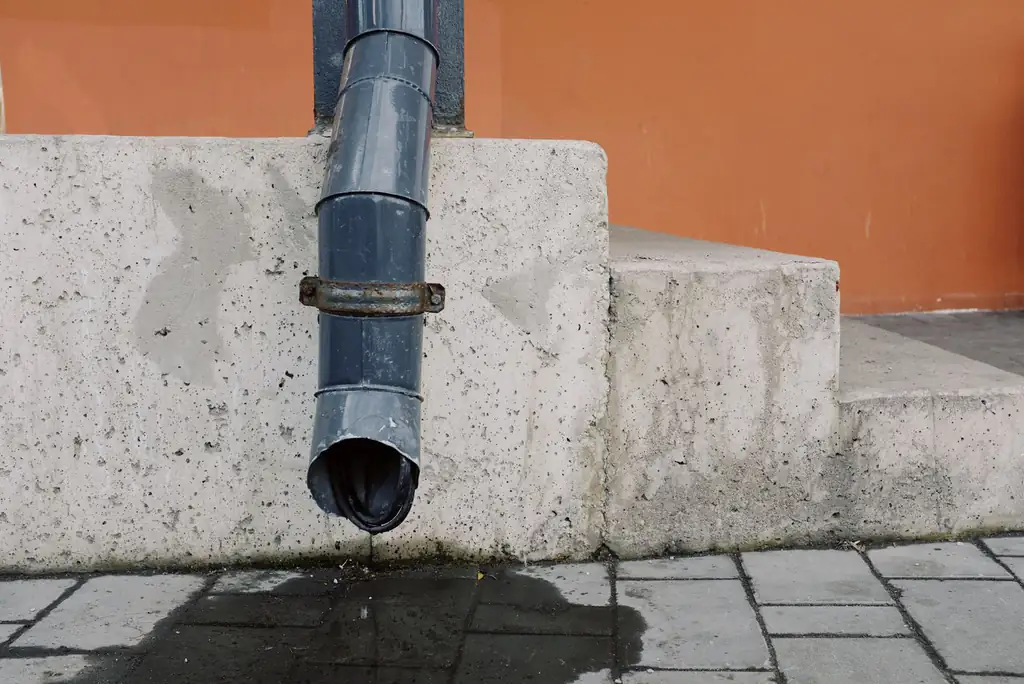
The last noise many people miss is at ground level, where water leaves the bottom elbow and slaps a splash block, a puddle, or a metal drain. Even a quiet pipe sounds loud if it dumps onto a hard, echoing surface right outside a window.
Extending the discharge, aiming it onto grass or gravel instead of concrete, or fitting a rubber splash guard softens that final sound and moves the water safely away from the foundation at the same time. See how far downspouts should extend for getting the discharge point right.
Most downspout noise is a nuisance, not a warning. But a new, irregular gurgle can mean water is backing up behind a partial clog, and a sudden change in sound is worth a look. If the downspout has started glugging, check that it is actually draining properly before you soundproof it, because silencing a pipe that is also overflowing just hides a drainage problem.
A noisy downspout is rarely a reason to replace anything. Identify whether you are hearing falling water or loose metal, break the fall with a rope or foam insert, soften the elbows, re-secure the brackets, and cushion the splash at the bottom. Work through those in order and all but the most stubborn downspouts go quiet, no new pipe required.
FAQ
The noise comes from water falling onto a hard, hollow surface. In a metal downspout, drips and streams strike the pipe wall and the elbow like a drum skin, and the hollow column amplifies the sound. Harder rain, taller drops, and thin metal all make it louder.
Give the water something soft to run down instead of open air to fall through. A length of rope or chain dropped inside the pipe, or a foam pipe insert, lets the water cling and trickle rather than free-fall and slap the metal, which removes most of the drumming.
Usually it is a loose bracket or a length of pipe that has worked free of the wall, so wind rattles it or it ticks as the metal expands and contracts with temperature. Re-securing the straps and adding a bracket on a long unsupported run stops the rattle.
Yes. Thin aluminum and steel resonate the most, vinyl is generally quieter because the plastic dampens vibration, and copper sits in between. You do not have to switch materials to fix noise, but if you are replacing a run anyway, vinyl or a lined pipe will start out quieter.
A rain chain changes the sound rather than silencing it, trading an internal drumming for an outdoor trickle that most people find pleasant. It only works where you can route water into the open, and it needs a solid basin or drainage below so you do not create a splashing puddle at the foundation.
It can. Water backing up and then surging past a partial blockage gurgles and glugs instead of running smoothly. If the noise is a new, irregular gurgle rather than a steady patter, check for a clog before trying to soundproof the pipe.
Keep reading
A downspout that won't drain is almost always clogged somewhere specific. Learn to find the blockage by working top-down, and how to clear it safely.
Why downspouts freeze in winter, the backup risk a frozen pipe creates, how to prevent it, and what you should never do to thaw one.
When upsizing to larger downspouts like 3x4 actually helps, why the gutter outlet has to match, and how to avoid simply relocating the bottleneck.